

In This Guide
- How to Travel to Bhutan: The 5 Rules That Make It Different
- Entry Requirements
- Top 4 "Must-Do" Experiences for Beginners
- Cultural Etiquette & Rules
- Practical Logistics
- When to Go?
- Quick Facts
- Is Bhutan Safe?
- Do You Need Travel Insurance for Bhutan?
- Food & Dietary Notes
- Altitude & Physical Fitness
- Tipping Etiquette
- A Typical Day in Bhutan
- Common First-Timer Mistakes
- Your Bhutan To-Do List
- Essential Planning Guides
How to Travel to Bhutan: The 5 Rules That Make It Different
Wondering how to visit Bhutan? The process is unlike anywhere else, but once you know the five rules, it's actually one of the easiest trips to arrange — because almost everything is done for you:
- You don't apply for a visa at an embassy. A licensed tour operator (like Byways) or the official portal handles it — you send a passport copy and photo, and the US$40 visa is processed within about five working days.
- You prepay the Sustainable Development Fee. The SDF of US$100 per adult per night is paid with your visa application, not on arrival — and the rate is locked until 31 August 2027.
- A licensed guide accompanies you. It's mandatory throughout your stay — and quickly becomes the best part of the system: translator, historian, fixer, and friend in one.
- Only two airlines fly in. Drukair and Bhutan Airlines connect Paro to regional hubs like Bangkok, Delhi, and Kathmandu — every route explained here. Confirm the Bhutan sector before booking your long-haul flight.
- Your trip is pre-arranged, not improvised. Hotels, transport, and permits are set before you land. Flexibility exists within days, but backpacker-style wandering isn't the model — and seats around major festivals sell out months ahead.
That's the whole system. Tell an operator your dates and interests, and the kingdom effectively organizes itself around you.
Entry Requirements
Bhutan's tourism model is based on "High Value, Low Volume." You cannot simply "backpack" into the country; your trip must be structured and pre-paid.
The Sustainable Development Fee (SDF)
This mandatory daily tax funds Bhutan's free healthcare, education, and environmental conservation.
International Adults
$100 USD
per person, per night
Children (6–11)
$50 USD
per person, per night
Indian Nationals
INR 1,200
per person, per night · locked until September 2028
Note: This rate is currently set until August 2027.
How to Get a Bhutan SDF Refund: Policies and Process If your travel plans change or your trip is cut short due to unexpected circumstances, you are eligible for a Sustainable Development Fee (SDF) refund. Please note that while the SDF is refundable, any applicable bank charges will be deducted from the final amount. All refund applications must be formally submitted to the Bhutan Department of Immigration for processing.
The Visa
A visa is required for all visitors except those from India, who need a permit instead. Nationals of Bangladesh and Maldives are eligible for visa on arrival. The visa costs $40 USD (non-refundable) and is processed by your tour operator like Byways Tours and Travels.
Landing at Paro
Have your passport and printed Visa Clearance Letter ready for the immigration counter, and fill in the arrival card handed out on the plane. Once you are through, your guide will be waiting outside arrivals with a signboard — they will help with your luggage and walk you to the vehicle. TashiCell and B-Mobile counters in the arrivals hall sell local SIM cards if you want one straight away.
Top 4 "Must-Do" Experiences for Beginners
If you only have 5 to 7 days, focus on the "Golden Triangle" of Paro, Thimphu, and Punakha.

Visit Tiger's Nest (Taktshang): The iconic cliffside monastery. It's a 4–6 hour hike that is the spiritual highlight of any trip to Bhutan. — Paro

Visit Punakha Dzong: Arguably the most beautiful fortress in the country, sitting at the confluence of two rivers. — Punakha
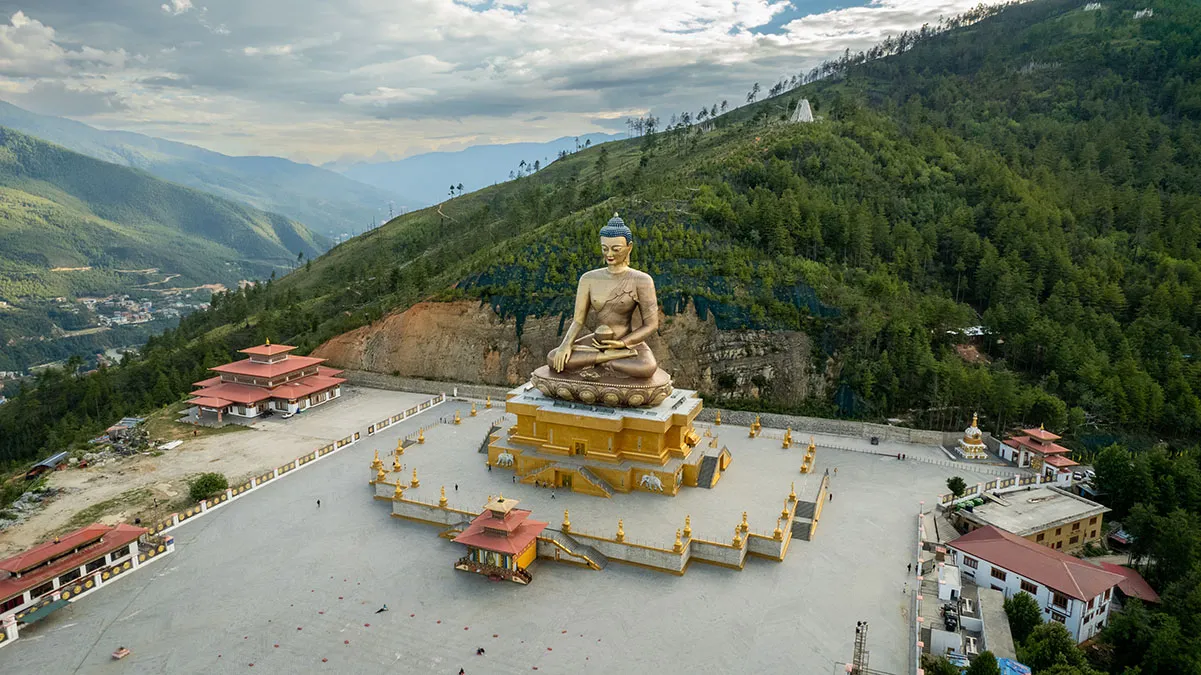
Visit Buddha Dordenma: A massive 169ft bronze Buddha overlooking Thimphu. It houses 100,000 smaller statues inside. — Thimphu

Visit Dochula Pass: A mountain pass at 3,100m featuring 108 chortens and panoramic views of the Himalayas. — Between Thimphu & Punakha
Cultural Etiquette & Rules
Bhutanese culture is deeply rooted in Vajrayana Buddhism. Following these local norms will make your visit much smoother:
-
Dress Modestly: When entering Dzongs (fortresses) or temples, you must wear long pants/skirts and long-sleeved shirts. No shorts, hats, or sleeveless tops are allowed inside sacred sites.
-
Photography Rules: You can take photos in courtyards, but photography is strictly forbidden inside the inner sanctums of temples and monasteries.
-
Clockwise is Key: Always walk to the left (clockwise) of Stupas (prayer monuments), prayer wheels, and mani walls. This follows the Buddhist tradition of circumambulation.
-
Tobacco: While no longer strictly banned, smoking in public places is highly discouraged and often prohibited. You can bring a limited amount for personal use, but expect to pay a high import tax (up to 200%).
What should I wear when visiting temples?
Long pants/skirts and long-sleeved shirts are required. No shorts, sleeveless tops, or hats inside Dzongs and temples. Dress modestly and remove shoes before entering.
Practical Logistics
Connectivity
Buy a local TashiCell or B-Mobile SIM card at the airport. Wi-Fi in hotels is generally decent.
Currency
The Ngultrum (Nu.) is pegged 1:1 to the Indian Rupee. Indian Rupees are widely accepted, but large denominations (₹500 and ₹2,000) can sometimes be difficult to use.
Roads
Bhutan is famous for its winding mountain roads. If you are prone to motion sickness, bring Dramamine for the drives between Paro, Thimphu, and Punakha.
Water
Never drink tap water. Stick to boiled or bottled water provided by your hotel and guide.
When to Go?
Spring (March–May)
Best for festivals & flowers
Best for blooming rhododendrons and the famous Paro Tshechu festival. The valleys come alive with color.
Autumn (September–November)
Best for clear mountain views
The clearest skies for mountain views and the Thimphu Tshechu. Considered the "Gold Standard" season by photographers.
Winter (December–February)
Best for off-season & photography
Cold but sunny. It's the "off-season," meaning fewer crowds and crisp, blue skies—perfect for photography!
First-Timer's Tip
For your first visit, we recommend 7 days focusing on the Golden Triangle (Paro, Thimphu, Punakha). This gives you enough time to acclimatize, see the major highlights, and soak in the culture without feeling rushed.
Quick Facts
Safety: Bhutan is one of the safest countries in Asia. Crime is extremely rare, and solo travelers (including women) report feeling completely safe. There's no "tourist hassle" from vendors.
Language: Dzongkha is the national language, but English is widely spoken in tourist areas, hotels, and by all licensed guides. You'll have no trouble communicating. Learning a few phrases and communicating in Dzongkha is highly appreciated by the locals. The Government Technology Agency has undertaken an initiative to provide a Dzongkha-English translation system, which may be helpful for learning the language before you travel to Bhutan.
Time Zone: Bhutan Standard Time (BTT) is UTC+6. There is no daylight saving time.
Electricity: 230V, 50Hz. Plug types are Indian-style round pins (Type D, M) and some UK-style (Type G). Bring a universal adapter.
Seniors: Bhutan is suitable for seniors. Most sightseeing is at a relaxed pace, and itineraries can be customized. However, the Tiger's Nest hike is strenuous—horses are available for part of the trail.
Is Bhutan Safe?
Yes — Bhutan is one of the safest countries you can visit. Violent crime against visitors is virtually unheard of, there is no hassle or scam culture around tourist sites, and you'll have a licensed guide with you throughout. Petty theft is rare enough that lost wallets famously find their way back.
The real risks are practical, not human: winding mountain roads (long drives, occasional landslides in monsoon), altitude (most tourist areas sit between 2,200m and 3,000m — see the fitness section below), and stray dogs best left unpetted. Basic emergency care at state hospitals is provided free, even to tourists — details in our health & safety guide.
Do You Need Travel Insurance for Bhutan?
Travel insurance is no longer mandatory for Bhutan — the requirement was lifted on 23 April 2024 — but it remains strongly recommended, and here's the honest reason: if a trek sprain or altitude problem requires helicopter evacuation, the bill without cover can run US$5,000–10,000.
Choose a policy that covers trip cancellation (flights and festival-season bookings are hard to move), medical treatment, and — if you're trekking — high-altitude activity and emergency evacuation. Full details in our health & safety guide.
Food & Dietary Notes
Bhutanese cuisine is simple but flavorful, with rice as the staple and chili as a vegetable (not just a spice).
Expect Spice: Bhutanese food is notoriously spicy. The national dish, Ema Datshi (chili and cheese), is delicious but fiery. Ask for "less spicy" if needed—hotels are used to adjusting for tourists.
Vegetarian-Friendly: Vegetarian options are readily available. Buddhism discourages meat consumption, so many locals eat vegetarian. Just inform your guide or hotel in advance.
Vegan/Gluten-Free: Possible with advance notice. Traditional dishes rely on cheese and butter, but hotels can accommodate special diets if informed beforehand.
Safe Eating: Stick to cooked food and bottled water. Avoid raw salads and ice outside of reputable hotels.
Altitude & Physical Fitness
Bhutan's destinations sit at moderate to high altitudes. Understanding what to expect helps you prepare.
Typical Elevations: Paro (2,200m), Thimphu (2,350m), Punakha (1,200m), Bumthang (2,600m), Dochula Pass (3,100m).
Altitude Sickness: Symptoms (headache, fatigue, shortness of breath) can occur above 2,500m. Take your first day slow, stay hydrated, and avoid alcohol initially.
Fitness Level: General sightseeing requires only moderate fitness. Walking through Dzongs involves stairs and uneven surfaces. The Tiger's Nest hike is strenuous (4-6 hours, steep sections).
For Seniors/Limited Mobility: Most Dzongs and monasteries are accessible with some walking. Inform your tour operator about mobility concerns—itineraries can be adjusted.
Tipping Etiquette
Tipping is not traditionally part of Bhutanese culture, though it has become customary in tourism. There is no fixed amount and no expected rate — what you give, and whether you give at all, is entirely your decision, guided by how you felt about the service.
Guides: If your guide made the trip what it was, a tip at the end, given once from the whole group, is the usual way to say so.
Drivers: Customarily thanked at the end of the trip too. Drivers work long days on demanding mountain roads, and the recognition matters to them.
Trekking crew: Pool something for the whole team — trek guide, cook and horsemen — and hand it over together at the end of the walk.
Hotels and restaurants: Not expected. A small note for exceptional service is appreciated, never assumed, and upscale hotel restaurants may already add a service charge.
How and when: Usually at the end of the trip, in an envelope handed over directly. Ngultrum and US dollars are equally welcome.
A Typical Day in Bhutan
Wondering what a day of sightseeing in Bhutan actually looks like? Here's what to expect:
Wake Up: Early starts are common. The morning light is magical, and Bhutanese sites are best experienced before crowds arrive.
Breakfast: Hotels serve a mix of continental and Bhutanese breakfast. Expect eggs, toast, and often traditional dishes like rice porridge.
Morning Sightseeing: Visit Dzongs, monasteries, or start a hike. Mornings are cooler and ideal for outdoor activities.
Lunch: A sit-down meal at a local restaurant or hotel. Expect rice, vegetables, and meat dishes. Lunch breaks are generous (1-1.5 hours).
Afternoon Activities: More sightseeing, village walks, or drives to the next destination. Afternoons often include scenic drives through mountain passes.
Return to Hotel: Time to freshen up, rest, or explore the town independently. Some travelers enjoy a traditional hot stone bath.
Dinner: Early dinners are the norm. Most restaurants close by 9 PM. Enjoy traditional Bhutanese cuisine or international options at your hotel.
Common First-Timer Mistakes
Learn from others' experiences. Here are the most common mistakes first-time visitors make:
-
Overpacking the Itinerary: Trying to see too much in too few days. The winding roads mean distances take longer than expected. Less is more—savor each destination. Our typical Bhutan itineraries show what realistically fits into 5 to 14 days.
-
Underestimating Altitude: Paro sits at 2,200m and Thimphu at 2,350m. Even if you're fit, take the first day slow. Drink plenty of water and avoid alcohol initially.
-
Forgetting Temple-Appropriate Clothing: Shorts, sleeveless tops, and hats are not allowed inside Dzongs and temples. Pack long pants and long-sleeved shirts.
-
Not Carrying Cash: Credit cards are accepted at major hotels but still cash is King. Carry enough Ngultrum or Indian Rupees for tips, souvenirs, and small purchases.
-
Skipping Motion Sickness Prep: Bhutan's mountain roads are famously winding. If you're prone to car sickness, bring medication and sit in the front seat.
-
Not Breaking in Hiking Shoes: The Tiger's Nest hike is no joke. Wear shoes you've already broken in—blisters can ruin the experience.
-
Photographing Inside Temples: Photography is strictly forbidden inside temple sanctuaries. Your guide will remind you, but putting the camera away before entering shows respect.
-
Expecting Fast WiFi Everywhere: While hotels in main towns have decent connectivity, remote areas have limited or no internet. Embrace the digital detox.
Your Bhutan To-Do List
The complete pre-trip checklist, in the order things actually happen:
- ☐ Check your passport is valid 6+ months beyond your departure from Bhutan
- ☐ Pick your dates — around a festival if you can (book 4+ months ahead for those)
- ☐ Contact a licensed operator — visa, SDF, hotels, guide and permits all get arranged for you
- ☐ Book flights once your Bhutan sector is confirmed (routes here)
- ☐ Arrange travel insurance (see above)
- ☐ Pack with our packing checklist — layers, sun protection, broken-in shoes
- ☐ Download WhatsApp and offline maps; decide on a SIM or eSIM
- ☐ Plan cash: bring USD to exchange, and read the money guide for tipping norms
- ☐ Print your visa clearance letter — you'll need it to board
Essential Planning Guides
Dive deeper into specific topics with our comprehensive guides:
- How to Get to Bhutan — Flights, routes & gateway cities
- How to Book Your Trip — Step-by-step booking process
- What to Pack — Complete packing checklist
- Typical Bhutan Itineraries — 5 to 14-day trip plans
- Food & Cuisine — What to eat in Bhutan
- Health & Safety — Altitude, vaccines & medical
- Money & Currency — ATMs, cards & budgeting
- Traveling in your 60s, 70s or beyond? — Our honest guide
Got more questions about Bhutan travel?
Our Bhutanese travel experts answer within a day — no question is too small.
Contact us